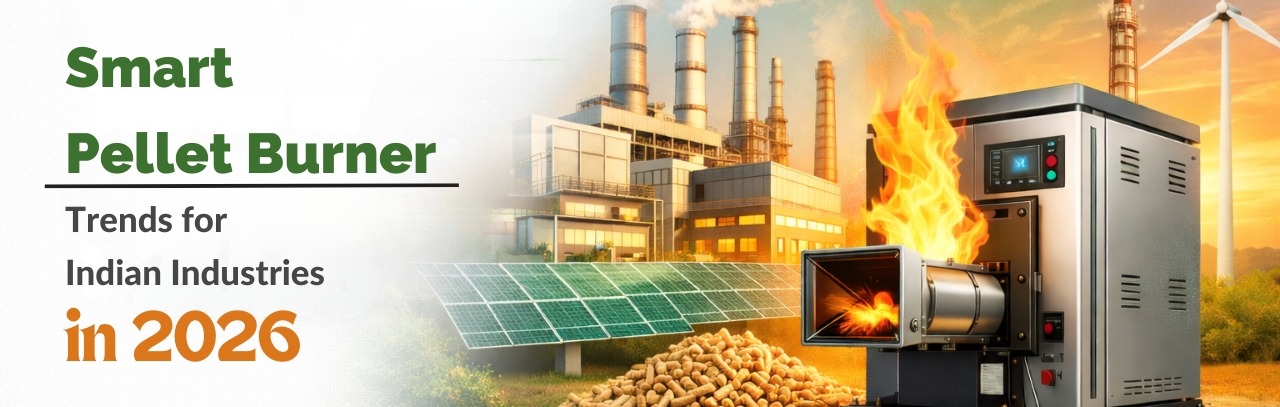
Fuel costs are climbing, emission norms are getting tighter. Industries in India feel the pressure every day. Traditional heating systems struggle to keep up. They waste fuel. They demand attention. They don’t adapt.
Smart pellet burners are different. They learn. They adjust. They perform better.
By 2026, these systems aren’t just an upgrade. They’re becoming the new normal.
A smart pellet burner is not just a burner with buttons.
It’s a biomass heating system equipped with sensors, automation, and IoT technology. It controls fuel feed. Regulates airflow. Monitors performance in real time. Some systems even tell you when maintenance is coming. Before things break. That’s the smart part.
The reasons are practical, Not theoretical, Energy costs keep rising. Government policies push for cleaner fuels.
Sustainability targets are no longer optional. Industries like food processing, textiles, pharma need stable heat always. Smart pellet burners check all the boxes.
1. IoT-Enabled Monitoring & Control
Managers can track temperature, fuel usage, and combustion quality remotely, On a screen, Anywhere
Less guessing Better decisions.
2. Automated Combustion Systems
Smart systems adjust fuel feeding and airflow on their own. No manual tuning, No constant checking. Fuel wastage reduces, Efficiency improves, Costs drop.
3. Integration with Renewable Energy
Smart pellet burners are now pairing with solar and other biomass systems. Hybrid energy setups are becoming common.
Less fossil fuel dependency. More energy stability.
4. Predictive Maintenance & Analytics
Sensors track trends. AI reads patterns. Alerts come early. Maintenance becomes planned, not reactive. Downtime stays low. Equipment life improves.
5. Energy Efficiency & Cost Optimization
When systems know how much fuel they’re consuming, they adjust automatically. Energy gets optimized. Costs stay under control. Sustainability improves quietly.
It’s efficiency with intelligence.
Yes, there are considerations.
Initial investment is higher. Teams need training. IoT features need stable internet. But with phased adoption and proper support, returns usually outweigh the effort.
In 2026, industrial heating in India will be smarter. More automated, Less wasteful.
Smart pellet burners sit right at that intersection—technology, sustainability, and cost efficiency. They aren’t a trend anymore. They’re infrastructure.
Smart pellet burners are changing how Indian industries generate heat. Automation, IoT Renewable integration, Together, they deliver control, savings, and environmental responsibility. Industries that adopt these systems in 2026 won’t just reduce costs. They’ll future-proof operations. And in today’s industrial landscape, that matters.





Find Clear and Helpful Answers to the Most Common Questions
Haryana
Yamuna Nagar-135001.
Karnataka
Bengaluru (Bangalore)-561203
Gujarat
Survey No 477, Tapar Ajapar Road Ajapar Kutch
Uttar Pradesh
Laharpur, Nabi Nagar Sitapur-261135
West Bengal
Bara Haripur Bangshihari Dakshin Dinapur-733121
Assam
Village – Dhansirikash,
P.O. – Shyamtila, P.S.-Dhula, Darrang,
Assam-78414
Plot number 22 khasra number 143 ground floor gali number 2 Kanjhawala industrial area delhi 110081
fireindustrialequipment@gmail.com
+91-9871484662
WhatsApp us